Tuesday, July 24, 2012

Various Eco Print Dye Experiments

Silk scarf with hibiscus print


Silk scarf with avocado, eucalyptus, iron nails and bamboo


Silk scarf with Iron nails bamboo and red onion skins


Silk tie with Iron nails, Eucalyptus and Golden bamboo eco prints


Upcycled recycled repurposed Girls t shirt from thrift shop with eucalyptus and red and yellow onion skin eco prints

Silk Men's Necktie with Silver Dollar eucalyptus, other eucalyptus and golden bamboo eco prints


My messy worktable with Ice dye cold bundle flowers, butterfly bush, Crocosmia "Lucifer", and Rose Campion, on silk scarf, pre-dyed with red cabbage....to go into freezer and hopefully turn out spectacular.  also a few leaves from the butterfly bush and one cherry leaf


A few scarves and skeins of yarn hanging from my wisteria tree


Wednesday, May 16, 2012

Unexpected Dye Color: Lavender from Red Sorrel

I noticed the Red Sorrel in my garden stained my hands, so I cut it all down, chopped it up and put it into a stainless pot. I had intended it for soup, but this purpose seemed more interesting. Reds, purples, and blues have been nonexistent in my dyer's palette so far, although I am still a novice.  I have now planted madder and am experimenting with Silver Dollar eucalyptus.

(Rumex sanguineus) or Blood Red Sorrel, seeds available from Baker's Heirloom Seeds 

May 12---harvested Red Sorrel leaves and stems, simmered an hour, rich ruby dye, so far. Added 2 Silk Scarves and 4 oz. Licorice Twist yarn from Dhama Trading, and 1 oz. skein of Gaia Organic 100% wool from Paradise Fibers. All had been previously mordanted in alum and soaked before adding to dye bath.

Heating it now, so far the dye bath is red, treated this very gently, and let sit overnight.  The dye bath was a beautiful ruby color.  Added the fibers the next morning, cold, and brought to low simmer.

Red scarf soon dries a lavender color


2 scarves came out maroon, drying to light purple, Gaia skein is very nice Oatmeal color, Licorice Twist skein grayish purple, with darker twist


 Scarf drying from dark maroon to mauve  on wisteria vine


Red Sorrel in the garden; this is a rare variety that I grew from seed, there is also a green variety, but I don't think that will dye.  The red has faded some in the last couple of years, and I haven't tried it again.

Friday, April 6, 2012

Dyes from the Blue Gum (eucalyptus) down the road


Eucalyptus globulus, a native to Australia, is fairly common on the Northern California coast.
The fresh eucalyptus leaves were cut up, boiled and left to sit overnight, and then an alum mordanted silk scarf and a tannin and alum mordanted cotton scarf were simmered for 3 hours in the dye bath.  They were left to cool in the dye and then rinsed.  The dye yielded a nice warm tan on the silk scarf, but the color of the cotton did not change, probably because the tannin mordant had already darkened it.


Silk scarf drying in the spring breeze.

I then added  an Iron modifyer, in the form of a ferrous sulphate solution, to the dye bath.  I dumped it in, and the dye bath turned dark blue immediately.  I would like to add the iron modifier more slowly next time, but it's all a learning process.
I wrapped up both scarves for tie-dyeing with rubber bands and immersed them in the now dark blue dye. 
I let them simmer in the hot dye bath for 10 minutes.  The effect was dramatic.  


Eucalyptus dye bath after adding Iron modifyer.

The Cotton scarf on the left, and the tie-dyed silk scarf on the right.  I am rather pleased with how the silk came out.  Cotton is a lot trickier, and I am not so stoked on the colors there.


supposedly, different varieties of Eucalyptus (and there are hundreds) dye various colors.  These next two wool skeins are from my son's tree, possible Eucalyptus rostrata or Red Gum Eucalyptus


The Copper Brown colored skein was dyed from the bark and stems and the yellow is from the leaves of the same tree.

Thursday, March 29, 2012

Dyeing with Daffodils and Scotch Broom

 I gathered Daffodils and Scotch Broom (Cytisus scoparius) and soaked them for 6 days, bringing them to a simmer twice.  I used only the petals on the daffodils and the flowers plus some of the young tips on the Scotch Broom.  The liquids had a brownish color, and I was a bit pessimistic about getting a nice color.  I used about 3 cups of daffodil flowers and covered them with water.  The Scotch Broom was more plentiful, and I soaked about 6 cups in a gallon of water.


 The wool yarn was alum mordanted.  I soaked it in water for 30 minutes before immersing in simmering dye bath.  I left the dye bath at simmer for an hour, and then I removed the yarn and rinsed it.
The Daffodils have a surprisingly strong golden yellow color.


The Scotch Broom gave a lighter and brighter yellow with tints of green.  I am very pleased with both samples.  I am saving the dye bath to use on larger items.  I also have some cotton which I have mordanted in tannin and now is in an alum mordant that I can try.


That's what's out there in nature right now.


Skein on the left is Dharma Trading Licorice Twist Merion Wool dyed with the Scotch Broom.  The yarn has a twist in it that picked up a darker tint.  Nice.  The scarf is silk dyed with Eucalyptus.


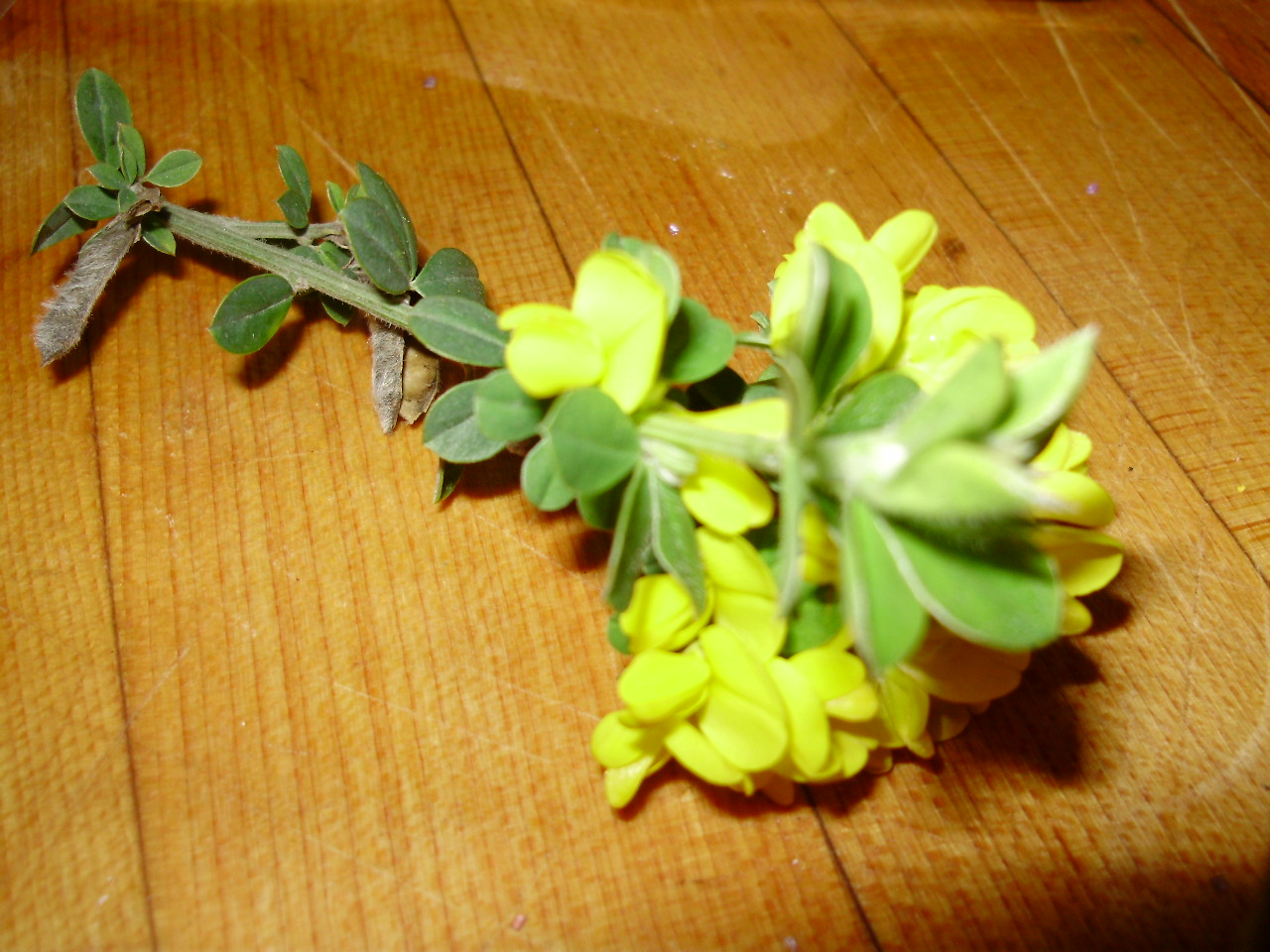
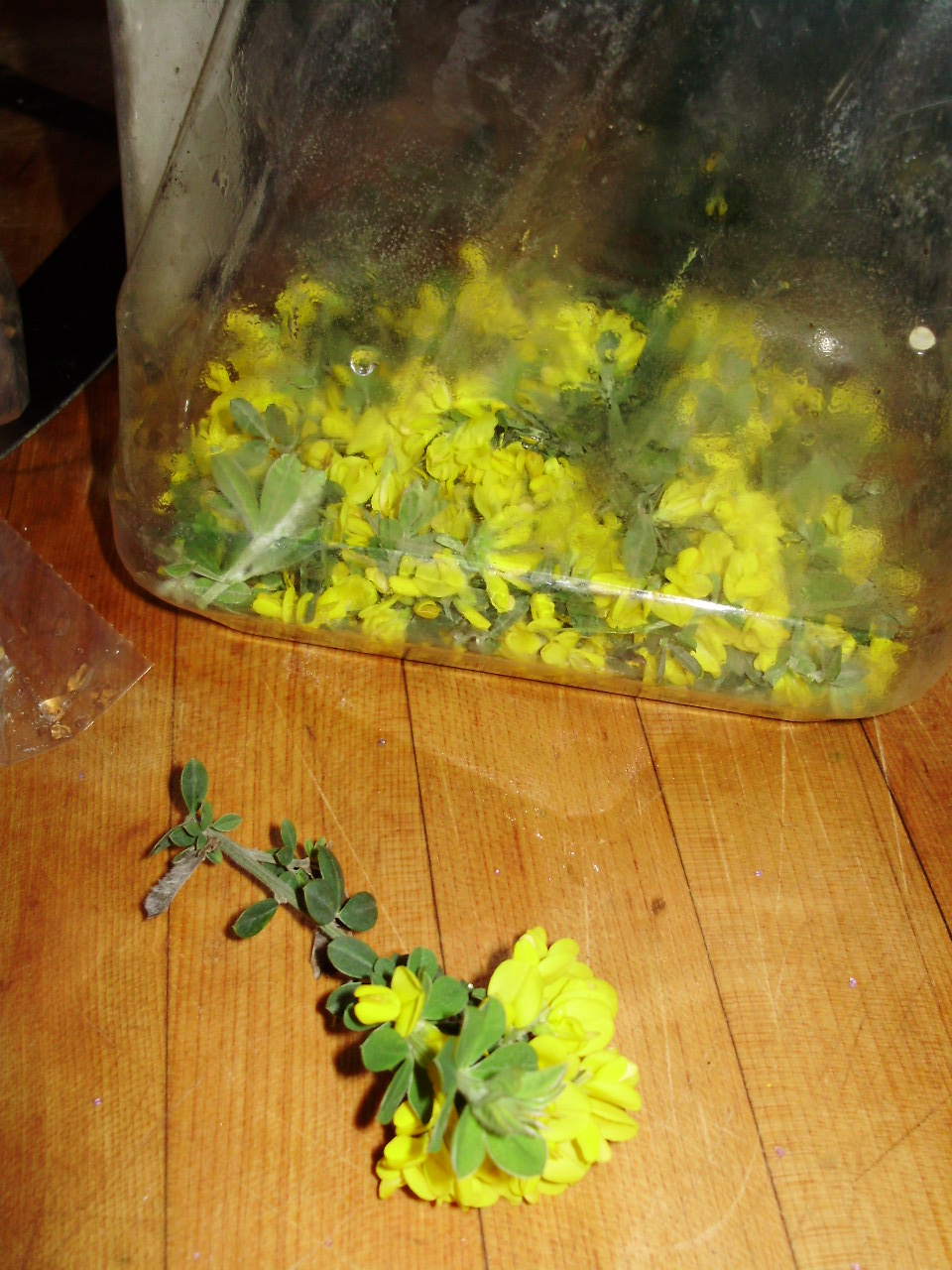
Big beautiful bowl of Scotch Broom flowers.  I am wondering if including many of the yellow-red type of flowers didn't give a greener shade.  Next time I will pick only the yellow and see.


Thursday, March 22, 2012

Gathering Dye Plants the Fun Way

Furthering the "Better Living through Dyeing" Philosophy, I bought a carrots for leaves; ate a carrot and felt healthier, saving the feathery green leaves in the freezer I can accumulate enough for a dye bath
On the way up Albion Ridge, I stopped by the side of the road to gather some much-maligned Scotch  Broom for dye, and of course, after walking a bit, I 
felt healthier.


I saved the flowers and some of the tops green leaves and stems and covered them with water.  I will wait a couple of days and watch for changes before steeping for an hour.


Scotch Broom Cytisus scopanius, Use the flowers + green stems with an alum mordant.  That should produce a
yellow or yellow/green on animal fibers.


Wednesday, March 21, 2012

Avocado Dyed Wool Yarn Variegated with Pits and Peels

I mordanted 8 oz. of Henry's Attic Sport yarn in Alum.  I did it a couple of weeks ago, and I just got around to the dye baths today.  The avocado pits and peels soaked in water for 10 days; I brought the dye bath to a simmer every couple of days.
Soaked the wool overnight in water, and added it to simmering dye baths this AM.  I did half of the yarn in the pits bath which is the lighter shade.  After an hour, I put the soaked undyed half in the simmering peels dye bath, and let it go for an hour at about 175 to 180 degrees.  


I love the coppery tones achieved with the avocadoes.  This will probably be a pair of socks, so the variegation is nice.


It may get lighter as it dries.


Really stoked about the whole project.  Now back to guacamole, carrots, daffodils and anything else I can find for dyes

Friday, March 9, 2012

Flower Smashing on Silk


March 9--Flower Smashing  Mordanted (alum) silk scarf, 
plastic on sturdy porch bench, old towel, silk scarf, flowers,
second plastic bag, wooden mallet
Flowers used: Viola, violet, grape hyacinth, violet leaves, 
kale leaves.
Results: Violas worked nicely, leaves were hard to get an 
impression from, kale didn't really work for me, violets
were to small, hyacinth seem to be good now, but some of 
the debris needs to dry and come off
Crepe de Chine may be the best type of silk for this
process, and the Habotai was rather flimsy.


This could be resmasheed, I think, maybe spraying with vinegar first to see what that does.